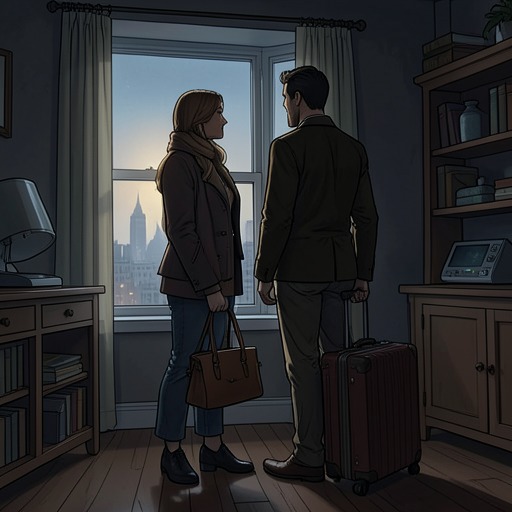
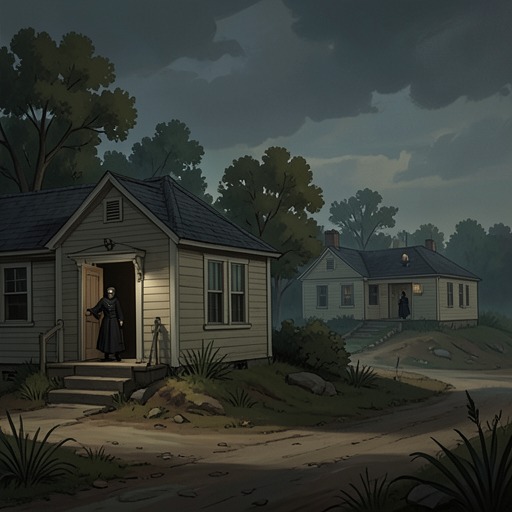
Ralph and Jeannie Anderson's home
The Outsider (Stephen King Edition)Ralph and Jeannie Anderson's home is the domestic center of the Andersons’ lives and, after Jeannie encounters an unexplained visitor, a crucial site in the investigation of the Outsider. The apparent breach is especially unsettling because the home’s alarm was set and there was no sign of entry; Holly Gibney’s later detection of faint stains on a chair and carpet gives the visitation physical traces without resolving how it occurred.
Domestic Setting and the Reported Visit
Jeannie recounts finding a light on downstairs and a man sitting beyond the archway on a chair from the kitchen table. She says that he warned her to tell Ralph to stop, and she remembers the fading blue letters inked on his fingers. Jeannie also reports fainting, an experience she says was new to her. Her account places the encounter inside an ordinary family interior: the kitchen furniture and archway are not atmospheric abstractions but specific points that can later be checked.
Ralph supplies the details that make the event harder to classify. Jeannie woke in bed, he says, and there was no sign that anyone had entered; the burglar alarm had been set. William Samuels dismisses the account as a dream, while Jeannie insists that it was real. The home thus becomes the scene of a dispute between ordinary explanations and a visitation that appears to have crossed the boundary of a secured private space.
The House as an Investigative Site
Holly returns to the house before full daylight because she wants to test for residue from the visitor. At her request, Ralph pulls the kitchen shades and Jeannie closes the living-room drapes. Holly uses markers and Scotch Magic Tape bought from Walmart to cover the flash on her iPhone: two strips colored blue, then a third colored purple. She asks Jeannie to identify the chair, turning the remembered position of the visitor into a specific location for examination.
The test reveals faint yellowish stains on the seat of the chair and several more on the carpet at the edge of the archway. Holly enlarges a carpet mark and points out that its right angle corresponds to one of the chair legs. The alignment links the stains to the reported scene rather than leaving them as undifferentiated discolorations. Ralph’s quiet reaction registers the importance of what they have found, while Holly’s procedure makes the house itself part of the evidence.
Household Objects and the Limits of Explanation
The evidence does not establish that the visitor passed through a door, nor does it explain how he appeared in a house whose alarm was active. Instead, the furnishings and fittings preserve a narrower but consequential fact: something was present at the chair and archway. A chair that ordinarily belongs to the shared routines of the household becomes a marker for an anomalous visit; the carpet, usually incidental underfoot, can be examined for a trace.
Jeannie then remembers that the light above the stove had been on. She explains that it has a button that must be pushed, and concludes that the visitor was present enough to do that. Her recollection adds a second domestic detail to the material clues. The stains indicate contact with the chair and carpet, while the stove light suggests interaction with another part of the room; neither detail supplies a conventional account of entry or departure.
The Home in the Wider Investigation
The Andersons’ house is also where the investigation’s human and supernatural strands meet. Holly arrives with her belongings after Ralph reads about her work as co-owner of Finders Keepers, and Jack Hoskins watches from down the block as she turns into the driveway and Ralph helps her inside. Hoskins sees her arrival, then experiences the appearance of someone in the passenger side of his truck; his neck wound begins to throb. That episode occurs outside the house, but its placement makes the home a visible point in the Outsider’s pressure on the investigators.
The investigation repeatedly depends on movement between places that differ in visibility and purpose. At the Vogel Transportation Center in Dubrow, a preliminary review draws on footage from sixteen cameras and a computerized record of trains and departures. Ralph later connects Dayton, Ohio, to Terry Maitland’s family trip and his visit to his father. Holly’s search of local newspaper archives links the abandoned van’s timeline to reports of the Howard sisters’ disappearance and deaths. Against these public, institutional, and distant sites, the Anderson home is intimate and locally knowable: its chair can be identified, its alarm status recalled, and its surfaces tested.
Significance
The house’s importance lies in the tension between the security it is supposed to provide and the unexplained presence reported within it. Jeannie’s insistence that the encounter was not a dream is initially opposed by Samuels’s ordinary explanation; the faint stains do not settle every question, but they prevent the episode from remaining only a matter of competing testimony. The domestic interior becomes a small evidentiary field where memory, physical traces, and the limits of police procedure converge.
That conversion is also unsettling because the investigation does not leave danger at the edges of town or in abandoned buildings. The warning is delivered inside the Andersons’ home, and its residue is found among familiar household objects. The house remains a family residence, but its ordinary features—an alarm, a chair, an archway, a stove light—have acquired a second meaning as witnesses to an event that the people inside it cannot readily explain.